
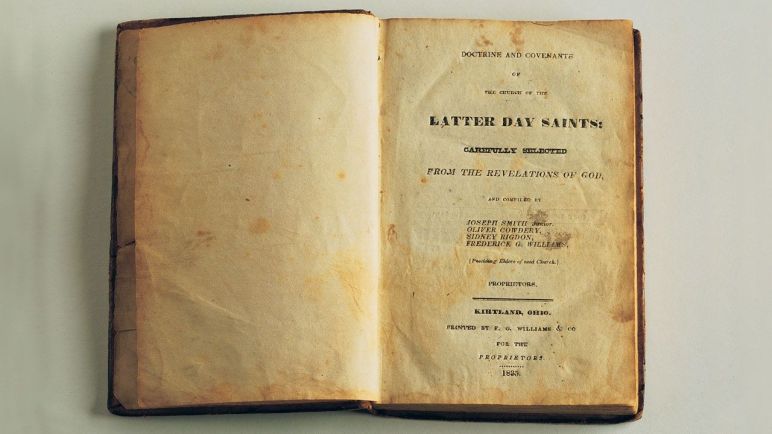
Could God have embedded a plot within the Doctrine and Covenants—one that no one ever thought to look for?
The Doctrine and Covenants is typically approached as a collection of discrete revelations addressing varied circumstances as the Restoration unfolded. But what if there is a unifying theme, even a narrative arc, running through the book? In my own study, I began to notice unexpected connections between sections that at first appeared unrelated. These connections deepened my understanding of individual revelations and suggested a coherent organizing purpose.
The first surprise came in reconsidering what truly constitutes the opening line of the Doctrine and Covenants. Most readers—after checking—would identify it as: “Hearken, O ye people of my church, saith the voice of him who dwells on high” (Doctrine and Covenants 1:1). It is a strong declaration, but it does not resonate in the way that the great opening lines of literature often do.
Most members of the Church can readily quote the opening line of the Book of Mormon: “I, Nephi, having been born of goodly parents…” (1 Nephi 1:1). Yet even that passage is not technically the first line of the book. One could point instead to the Title Page—“Wherefore, it is an abridgment of the record of the people of Nephi…”—or to the editorial heading preceding 1 Nephi. Still, no one treats those as the book’s true opening. The Nephi passage functions as the thematic threshold, regardless of prefatory material.
The same pattern holds in literature more broadly. Memorable opening lines—“It was the best of times, it was the worst of times”—are not found in prefaces. They introduce the core work and often announce its governing theme. Section 1 of the Doctrine and Covenants is explicitly labeled a preface. If so, then what revelation actually opens the book in a thematic sense?
I propose that it is Section 2.
When I have asked members over the past several months what Section 2 contains, not one of more than a hundred people has been able to say. Yet once it is read aloud, many immediately recognize and can even finish it. More importantly, it declares a theme worthy of an entire volume of scripture:
“Behold, I will reveal unto you the Priesthood, by the hand of Elijah the prophet… And he shall plant in the hearts of the children the promises made to the fathers… If it were not so, the whole earth would be utterly wasted at his coming.” (Doctrine and Covenants 2)
This is nothing less than a declaration of the sealing power—how humanity is prepared for the Lord’s coming, how authority is restored, and how generations are bound together.
Section 2 is drawn from Moroni’s first visit to Joseph Smith on September 21, 1823. Joseph initially described the First Vision as a communication directed to him personally. By contrast, Moroni’s message—particularly this passage—functioned as a revelation to the world. Indeed, throughout much of the nineteenth century, missionaries taught that the Restoration began not in the grove, but with Moroni’s visit. In that sense, Section 2 represents the opening proclamation of this dispensation.
As Russell M. Nelson recently taught: “Without priesthood keys, the Church could serve only as a significant teaching and humanitarian organization but not much more” (“Rejoice in the Gift of Priesthood Keys,” April 2024).
With this perspective, the Doctrine and Covenants begins to read as a sustained exploration of how priesthood authority is restored, organized, safeguarded, and exercised. To make this structure more visible, I developed titles for each section and grouped them thematically, highlighting each revelation’s role in the larger plot. Along the way, other patterns emerged—for example, Sections 18–21 outline the first principles of the gospel; Sections 30–40 function collectively as an early missionary manual; and modern Church committees find clear antecedents in specific sections.
I offer this framework in the hope that it may enrich others’ study of the Doctrine and Covenants. It has certainly enriched mine.
- Section 1: The Preface
- Section 2: Doctrine and Covenant’s Theme: The Sealing Power by Elijiah’s Hand
- Personal Salvation:
- Section 3: Laws, repentance, priesthood, Book of Mormon
- Section 4: Family and virtue
- Section 5: Authorized servants
- Section 6: Personal conversion and witness of the spirit
- Prophetic Gifts:
- Section 7: Written word (scripture)
- Section 8: Translation
- Section 9: Revelation
- Section 10: Responsibility for oracles
- Section 11: Gain word first, wait for authority
- Aaronic Priesthood:
- Section 12: Prepare for the Priesthood
- Section 13: Restoration of Aaronic Priesthood
- Section 14: Some responsibilities are unique
- Section 15 and 16: Many responsibilities are common
- Section 17: Prophetic witnesses in presidencies
- Fundamental Principles:
- Section 18: Faith
- Section 19: Repentance
- Section 20: Baptism (and Articles of the Church)
- Section 21: Gift of the Holy Ghost: Prophets
- Section 22: New Baptism
- Section 23: Institutional Revelation
- Section 24: 1st and 2nd Elders
- Section 25: Role of Leaders
- Section 26: Basic Church Callings
- Section 27: Sacrament, a recurring church ordinance for the community
- Section 28: Order in Revelation, church administration, and Zion
- Section 29: World History Overview: Second Coming precedes Zion
- The First Missionary Manual:
- Section 30: Personal missions and callings (Compare Sections 14-16)
- Section 31: Mission Prep, focus on family
- Section 32: Formal Missionary Callings
- Section 33: First Missionary Handbook
- Section 34: Model Missionary Interview
- Section 35: Mission President Call and Duty (Reference to Elijiah)
- Section 36: Missionary Ordination (and laying on of hands for other callings)
- Section 37: Organizational Results of Missionary Work
- Section 38: Gathering, the doctrine
- Section 39: A sample missionary discussion
- Section 40: Some investigator’s reactions
- Church Law
- Section 41: Law Preface: The Bishop’s agent
- Section 42: The Law
- Section 43: The Law Postscript: Prophets can amend
- Basic Church Operations:
- Section 44: Purposes of conferences
- Section 45: Detail on 2nd Coming, gathering, and external view of Zion
- (Operations continues)
- Section 46: Meetings, talents (spiritual gifts) and work in the church
- Section 47: Histories, Callings and Sacrifice
- Section 48: Living, working and saving are important
- Section 49 and 50: Avoid extremes, teaching, meetings, counseling, the Spirit
- Section 51: Bishop is financial agent.
- Section 52: Travel assignments for leading elders
- Section 53: Church employees
- Section 54: Branch operations
- Section 55: Church printing press
- Section 56: Correction, repentance, revoking, and finances
- Zion
- Section 57: Zion is more than a church: it is a place
- Section 58: Qualifications for and gov’t of Zion, repentance, and initiative
- Section 59: Life in Zion
- Travel to and From Zion
- Section 60 and 61: Travel from Zion
- Section 62: Travel to Zion
- View from Outside Zion
- Section 63 and 64: Qualifying to go to Zion
- Section 65: What happens after Millennium: Kingdom of Heaven from Kingdom of God
- Section 66: Remember the basics
- Church Committees
- Section 67: Church scripture committee
- Section 68: General authorities, presiding bishopric, employment and families
- Section 69: Church audit, accounting, and history (record keeping) committees
- Section 70: Church finance committee
- Section 71: Public relations committee
- Section 72: Church unit network and hierarchy
- Section 73: Church conferences and academic research
- Section 74: Family and priesthood committee
- Section 75: Missionary committee
- (Temple committee pending)
- The Vision
- Section 76: The Vision: Builds on sections 29, 45, and 65
- Section 77: Interpretation of revelations
- Corporation of the Church
- Section 78: Form the Corporation of the President of the Church
- Sections 79 and 80: Member responsibilities
- Section 81: Corporate leadership: 1st Presidency
- Section 82: Corporate officers and conduct
- Section 83: Member Financial Duties: wives and children
- Authority
- Section 84: Priesthood authority
- Section 85: Apostacy
- Section 86: Contrast of authority and apostacy
- Section 87: Result of apostacy
- Section 88: Authority of universal law
- Section 89: Law of our mortal bodies
- Section 90: Keys of 1st Presidency
- Section 91: Church literature
- Section 92: Corporate board amendments
- Section 93: Fundamental doctrine: What God Is
- Buildings
- Section 94: Church building committee
- Section 95: Houses of worship
- Section 96: Other properties
- Section 97: Temples
- Opposition: From temple announcement to dedication:
- Section 98: Response to opposition in civil society
- Section 99: Familial sacrifices
- Section 100: Leadership sacrifices
- Section 101: Sin in the community; a cause of opposition
- Section 102: Church discipline in temple preparation
- Section 103: Helping Hands: a call for response to opposition
- Section 104: Personal stewardships: personal progress in the face of opposition
- Section 105: Broad definition of the requirements for Zion, and its organization
- Section 106: Governing structure preface: Stake president is a presiding high priest
- Section 107: The structure of priesthood organization
- Section 108: Individual Leader responsibilities in building Zion
- Section 109: Temple dedicatory prayer
- Restoration of priesthood keys:
- Section 110: Required keys for temple (Malachi quoted)
- Section 111: Mortal concerns continue even with temple and priesthood
- Section 112: President of Quorum of the Twelve holds the priesthood keys
- Section 113: Christ, Joseph Smith, and current prophet use key to gather and build Zion
- Section 114: Twelve to commit all
- Section 115: Church to arise and shine through stakes and temples
- Section 116: All dispensation keys will be gathered at Adam-ondi-Ahman
- Sealing requires being qualified by trials:
- A Day of Preparation, July 8, 1838
- Section 117: Failure (by men’s standard) is not failure in God’s eyes
- Section 118: Prepare for (unexpected) missions
- Section 119: Sacrifice is still required (tithing)
- Section 120: Disposition of tithing
- Days of Qualification, March 20–22, 1839
- Section 121: Some suffering is at hands of authority
- Section 122: Savior’s suffering exceeds all
- Section 123: Truth of mistakes is recorded
- (Conclusion: Transfer, escape from jail then Missouri April 6, 16 & 22; Twelve travel and fulfill prophecy April 24–26)
- A Day of Preparation, July 8, 1838
- Temple Ordinances:
- Section 124: The community hosts the temple
- Section 125: Even extended communities influence
- Section 126: Family (and temple) central to responsibility of Twelve
- Section 127: Worldly agents and temple order
- Section 128: The sealing of agent ordinances (Malachi quoted)
- Section 129: Heavenly beings
- Section 130: Heavenly sociality and conditions
- Section 131: Heavenly home of the sealed
- Section 132: The sealing power and fundamental relationships: Marriage and Family
- Conclusion to apocalyptic sections (29, 45, 65, 76, 77, 88):
- Section 133: The Sealing Power prepares a people for the 2nd Coming
- Section 134: The relationship of the Sealing Power to secular society in eternity
- Section 135: The failure of all other authorities
- Section 136: The sealing power creates covenant communities
- Section 137: Entering into heaven
- Section 138: Impact of the Sealing Power beyond the veil
 Kip on Character