
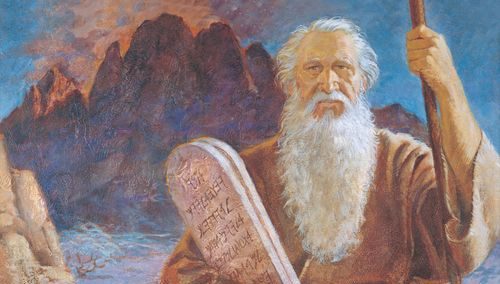
This BYU Studies article discusses how it might have been possible for Abraham’s writings between 2,000 to 1,800 BC to end up on a papyri created a millennia and a half later which was then translated by Joseph Smith in the 1830s. My study of the Pearl of Great Price made me wonder if Moses, living between those dates, might have come in contact with Abraham’s writings?
As Pharaoh’s adopted grandson, (Exodus 2:10) Moses may well have had a superior education. Pharaoh would have had one of the great libraries of the world at the time, used for the education of the pharaohs. As Moses became aware of his heritage, he well could have searched out Abraham’s writings.
(In fact, I wonder if it is possible Moses’ copy of the writings from Adam on that we have now as Genesis might have come into his hands from the Egyptian library, rather than from the children of Israel who were at that time slaves.)
Reading Abraham and Moses’ writings in the Pearl of Great Price and looking for things that resonate between them is interesting. Here are a few points I have noted:
- Importance of Adoption by God: Abraham chapter 1 is focused on Abraham being a son of God, even though his fathers were not righteous. Moses had learned before writing Moses chapter 1 that his adopted father was not his real father. It must have been meaningful to both to have the Lord call each “my son” (Abraham 1: 17 and Moses 1:6).
- Confronting Evil: Abraham chapter 1 includes vivid details of his near sacrifice at the hands of an idolatrous priest (Abraham 1:5–19). This would have resonated with Moses’ experience with Satan in Moses 1:12–23. The history of the founding of Egypt, and the lack of priesthood authority (Abraham 1:20–28) would also have strongly resonated with Moses’ recent realization of his true heritage.
- Sojourn in Egypt: Although not in the book of Abraham, Genesis records that Abraham became rich while dwelling in Pharoah’s court (Genesis 12:10–20 and 13:1–2). This likely resonated with Moses, his favored status while there, all that he was able to become, and his feelings, like Abraham, of being a stranger in a strange land (Genesis 17:8 and Exodus 2:22).
- World Creation: The visions of the cosmos and the creation of the world are very similar, in Moses 1:27–29 and chapters 2 and 3 and the pre-mortal counsel in Moses 4:1–4 compared to Abraham chapters 3, 4 and 5.
This line of reasoning generated additional possible insights, particularly about Moses.
- Trained for Theophany: If Moses was being raised to potentially become Pharoah, he would have been instructed that his role was to meet God. That’s what pharaohs did. He thus might not have been tremendously surprised by his theophanies, having only to adjust the god he was to meet from Ra to Jehovah.
- Law of Moses Model: I have thought how incredible it was for one man to conceive of the entire law of Moses, but given this background and training, that’s not what Moses likely did. The Law of Moses was likely modeled significantly on Egyptian practices, adjusted of course by revelation Moses received about Jehovah’s purposes. Abraham’s comment about the righteousness of Pharoah’s intent in leadership would have increased Moses’ confidence (Abraham 1:26).
- Holy Nation: Although Moses was very meek (Number 12:3), he must have been very, very confident, having been raised to it in Pharaoh’s court (unlike Joseph Smith’s very humble background). The Lord used Moses’ training to inspire him to create the foundations for a kingdom of even greater glory than Egypt, that of the House of Israel (Exodus 19:3–6).
Although of course this is all speculative, It is interesting to consider how Moses, the head of a dispensation, might have been affected by the writings of Abraham in Egypt, the head of the prior dispensation.
 Kip on Character